Monday, June 13, 2011

Windows Keyboard shortcuts

Windows system key combinations

  • F1: Help
  • CTRL+ESC: Open Start menu
  • ALT+TAB: Switch between open programs
  • ALT+F4: Quit program
  • SHIFT+DELETE: Delete item permanently
  • Windows Logo+L: Lock the computer (without using CTRL+ALT+DELETE)

Windows program key combinations

  • CTRL+C: Copy
  • CTRL+X: Cut
  • CTRL+V: Paste
  • CTRL+Z: Undo
  • CTRL+B: Bold
  • CTRL+U: Underline
  • CTRL+I: Italic

Mouse click/keyboard modifier combinations for shell objects

  • SHIFT+right click: Displays a shortcut menu containing alternative commands
  • SHIFT+double click: Runs the alternate default command (the second item on the menu)
  • ALT+double click: Displays properties
  • SHIFT+DELETE: Deletes an item immediately without placing it in the Recycle Bin

General keyboard-only commands

  • F1: Starts Windows Help
  • F10: Activates menu bar options
  • SHIFT+F10 Opens a shortcut menu for the selected item (this is the same as right-clicking an object
  • CTRL+ESC: Opens the Start menu (use the ARROW keys to select an item)
  • CTRL+ESC or ESC: Selects the Start button (press TAB to select the taskbar, or press SHIFT+F10 for a context menu)
  • CTRL+SHIFT+ESC: Opens Windows Task Manager
  • ALT+DOWN ARROW: Opens a drop-down list box
  • ALT+TAB: Switch to another running program (hold down the ALT key and then press the TAB key to view the task-switching window)
  • SHIFT: Press and hold down the SHIFT key while you insert a CD-ROM to bypass the automatic-run feature
  • ALT+SPACE: Displays the main window's System menu (from the System menu, you can restore, move, resize, minimize, maximize, or close the window)
  • ALT+- (ALT+hyphen): Displays the Multiple Document Interface (MDI) child window's System menu (from the MDI child window's System menu, you can restore, move, resize, minimize, maximize, or close the child window)
  • CTRL+TAB: Switch to the next child window of a Multiple Document Interface (MDI) program
  • ALT+underlined letter in menu: Opens the menu
  • ALT+F4: Closes the current window
  • CTRL+F4: Closes the current Multiple Document Interface (MDI) window
  • ALT+F6: Switch between multiple windows in the same program (for example, when the Notepad Find dialog box is displayed, ALT+F6 switches between the Find dialog box and the main Notepad window)

Shell objects and general folder/Windows Explorer shortcuts

For a selected object:
  • F2: Rename object
  • F3: Find all files
  • CTRL+X: Cut
  • CTRL+C: Copy
  • CTRL+V: Paste
  • SHIFT+DELETE: Delete selection immediately, without moving the item to the Recycle Bin
  • ALT+ENTER: Open the properties for the selected object

To copy a file

Press and hold down the CTRL key while you drag the file to another folder.

To create a shortcut

Press and hold down CTRL+SHIFT while you drag a file to the desktop or a folder.

General folder/shortcut control

  • F4: Selects the Go To A Different Folder box and moves down the entries in the box (if the toolbar is active in Windows Explorer)
  • F5: Refreshes the current window.
  • F6: Moves among panes in Windows Explorer
  • CTRL+G: Opens the Go To Folder tool (in Windows 95 Windows Explorer only)
  • CTRL+Z: Undo the last command
  • CTRL+A: Select all the items in the current window
  • BACKSPACE: Switch to the parent folder
  • SHIFT+click+Close button: For folders, close the current folder plus all parent folders

Windows Explorer tree control

  • Numeric Keypad *: Expands everything under the current selection
  • Numeric Keypad +: Expands the current selection
  • Numeric Keypad -: Collapses the current selection.
  • RIGHT ARROW: Expands the current selection if it is not expanded, otherwise goes to the first child
  • LEFT ARROW: Collapses the current selection if it is expanded, otherwise goes to the parent

Properties control

  • CTRL+TAB/CTRL+SHIFT+TAB: Move through the property tabs

Accessibility shortcuts

  • Press SHIFT five times: Toggles StickyKeys on and off
  • Press down and hold the right SHIFT key for eight seconds: Toggles FilterKeys on and off
  • Press down and hold the NUM LOCK key for five seconds: Toggles ToggleKeys on and off
  • Left ALT+left SHIFT+NUM LOCK: Toggles MouseKeys on and off
  • Left ALT+left SHIFT+PRINT SCREEN: Toggles high contrast on and off

Microsoft Natural Keyboard keys

  • Windows Logo: Start menu
  • Windows Logo+R: Run dialog box
  • Windows Logo+M: Minimize all
  • SHIFT+Windows Logo+M: Undo minimize all
  • Windows Logo+F1: Help
  • Windows Logo+E: Windows Explorer
  • Windows Logo+F: Find files or folders
  • Windows Logo+D: Minimizes all open windows and displays the desktop
  • CTRL+Windows Logo+F: Find computer
  • CTRL+Windows Logo+TAB: Moves focus from Start, to the Quick Launch toolbar, to the system tray (use RIGHT ARROW or LEFT ARROW to move focus to items on the Quick Launch toolbar and the system tray)
  • Windows Logo+TAB: Cycle through taskbar buttons
  • Windows Logo+Break: System Properties dialog box
  • Application key: Displays a shortcut menu for the selected item

Microsoft Natural Keyboard with IntelliType software installed

  • Windows Logo+L: Log off Windows
  • Windows Logo+P: Starts Print Manager
  • Windows Logo+C: Opens Control Panel
  • Windows Logo+V: Starts Clipboard
  • Windows Logo+K: Opens Keyboard Properties dialog box
  • Windows Logo+I: Opens Mouse Properties dialog box
  • Windows Logo+A: Starts Accessibility Options (if installed)
  • Windows Logo+SPACEBAR: Displays the list of Microsoft IntelliType shortcut keys
  • Windows Logo+S: Toggles CAPS LOCK on and off

Dialog box keyboard commands

  • TAB: Move to the next control in the dialog box
  • SHIFT+TAB: Move to the previous control in the dialog box
  • SPACEBAR: If the current control is a button, this clicks the button. If the current control is a check box, this toggles the check box. If the current control is an option, this selects the option.
  • ENTER: Equivalent to clicking the selected button (the button with the outline)
  • ESC: Equivalent to clicking the Cancel button
  • ALT+underlined letter in dialog box item: Move to the corresponding item

Gmail Keyboard shortcuts

Activating Gmail’s Keyboard Shortcuts
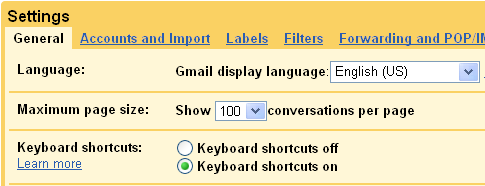
Before these shortcuts can be used you have to make sure that the Keyboard Shortcuts Setting for Gmail is set to “on” in Gmail Settings as shown here:
Gmail-Keyboard-shortcuts

These combinations of keystrokes speed up navigating among top level views such as Inbox, Sent Mail, All Mail, Spam, Trash, Drafts, Contacts and Tasks.  All letters in the keystroke combinations are shown in lower case but are not case sensitive. An example: “g then i” means press the “g” key then the “i” key, one right after the other.
  • g then i –  Open the Inbox.
  • g then s –  Open Starred.
  • g then t –  Open Sent Mail.
  • g then d –   Open Drafts.
  • g then a –  Open All Mail.
  • g then c –  Open Contacts.
  • g then k –  Open Tasks.

Gmail Selection and Management Shortcuts

These combinations of keystrokes are used within a specific view such as Inbox or All Mail to assist with quickly managing messages and conversations.
  • * then a –    Select all conversations.
  • * then n –    Deselect all conversations.
  • * then r –    Select only read conversations.
  • * then u –    Select only unread conversations.
  • * then s –    Select only starred conversations.
  • * then t –    Select only unstarred conversations.
  • x — Select a specific conversation; puts a check in checkbox; works as a toggle.
  • s – Stars a specific conversation; works as a toggle.
  • . – Open the More Actions dropdown list; works as a toggle.
  • e — Archive a conversation from current View into the All Mail View.
  • l – Open the Labels dropdown list to allow you to apply a label to a conversation.
  • # — Move the selected conversation to the Trash.
  • <Shift> + i — Mark selected conversations as read.
  • <Shift> + u – Mark selected conversations as unread.

Gmail Message Navigation Shortcuts

These Gmail keyboard shortcuts are used for navigating within conversations lists or views. The small black arrow at the left of the conversation list indicates the current conversation focus.
  • u – Return to conversation list (View) from current conversation.
  • k – Move to newer conversation; location indicated by black arrow on left.
  • j – Move to older conversation; location indicated by black arrow on left.
  • <Enter> or o –    Open selected conversation; black arrow indicates selection.
  • <Shift> + <Enter> or <Shift> + o — Open a conversation in a new window; black arrow indicates selection.
  • p — Read previous message within a conversation.
  • n — Read next message within a conversation.
  • r – Reply to sender when a conversation is open.
  • <Shift> + r — Open the reply in a new window.
  • a — Reply to all when a conversation is open.
  • <Shift> + a — Open the reply to all in a new window.
  • f — Forward current conversation when a conversation is open.
  • <Shift> + f — Open the forward current conversation in a new window.
  • <Ctrl> + s — Save a new or edited conversation as a draft. Cursor must be in a text field.
  • [ -- Archive the current conversation and move to the previous one.
  • ] – Archive the current conversation and move to the next one.

Gmail General Top Level Shortcuts

  • c – Open a new message.
  • <Shift> + c – Open a new message in a new window.
  • / — Move cursor to the entry box for Search Mail.
  • z – Undo previous action. Mainly used when typing and works as an “undelete”.
  • Esc – Remove the cursor from a search box or any input field.
Standard Windows shortcuts such as <Ctrl> + c, <Ctrl> + x and <Ctrl> + v are also useable within Gmail when editing text. Most browser shortcuts such as <spacebar> and Shift + <spacebar> for scrolling up or down a page are also usable.